
How to Write a Medical Coding Resume With No Coding Experience
You earned your certification. You completed the coursework. You learned ICD-10-CM, CPT, HCPCS, medical terminology, anatomy, coding guidelines, and the rules that go along with assigning codes accurately.
Then you start looking at medical coding job postings and see the same frustrating requirement over and over again:
Experience preferred.
So how are you supposed to write a medical coding resume when you do not yet have medical coding experience?
The answer is not to pretend you have experience you do not have. It is to make sure your resume clearly shows the knowledge, training, credentials, and transferable experience you do bring to the table.
A strong entry-level medical coding resume should help an employer understand three things quickly:
You have completed relevant coding education and training.
You understand the skills required to perform the work.
Your previous experience has helped you develop abilities that can transfer into a coding role.
Here is where to start.
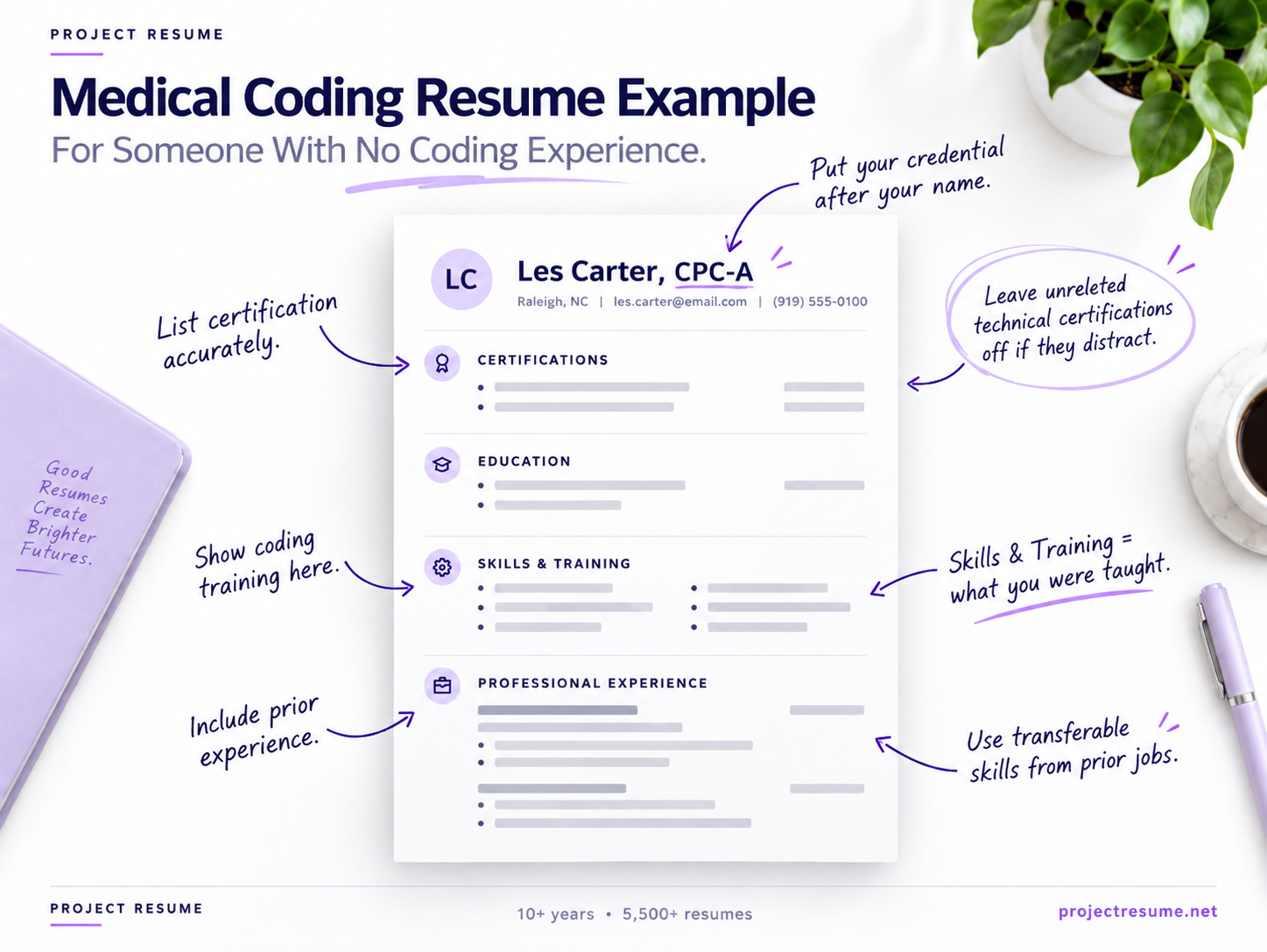
1. List Your Medical Coding Credentials Accurately
Your certification should be easy to find on your resume.
Just as importantly, it should be listed accurately.
If you currently hold the CPC-A, list yourself as a CPC-A. Do not remove the apprentice designation and present yourself as a CPC if you have not yet met the requirements for its removal.
Employers who hire medical coders understand what the apprentice designation means. There is no need to hide it, and presenting a credential inaccurately can create a much larger problem than simply being an entry-level candidate.
Your credential section may include items such as:
CPC-A
CCS
CCA
Certified Billing and Coding Specialist credentials
Other current coding, billing, HIM, or healthcare certifications
If you have completed additional training such as Practicode, specialty education, or another formal coding program, that can also be included where appropriate.
The goal is simple: make it immediately clear what you have earned and where you are in your professional development.
2. Make Your Education and Coding Training Prominent
When you do not have direct coding experience yet, your education carries more weight.
Do not bury it at the bottom of the resume as though it is an afterthought.
Include the coding program, school, training provider, or credential-preparation course you completed. Depending on your background, you may also want to include relevant college education, healthcare training, or other certifications.
For a newly certified coder, your education helps answer an important question for the employer:
Where did this candidate develop their coding knowledge?
Make that answer easy to find.
3. Build a Skills and Training Section
One of the biggest mistakes entry-level coders make is assuming they cannot list coding skills because they have not yet used them in a paid coding job.
There is an important difference between claiming professional experience and identifying skills you were trained to perform.
If your coding education included training in a subject, it may belong in a Skills & Training section.
Depending on your credential preparation, that may include areas such as:
ICD-10-CM
CPT
HCPCS Level II
Medical terminology
Anatomy and physiology
Evaluation and Management coding
Coding guidelines
Modifier application
Compliance and reimbursement concepts
Medical record review
Diagnosis coding
Procedure coding
Healthcare documentation
Insurance terminology
Revenue cycle concepts
Your exact list should reflect what you actually studied and learned.
Do not simply copy a generic medical coder skill list from the internet.
Go back through your course syllabus, study materials, certification preparation, Practicode work, and other training. Ask yourself:
What did I actually learn how to do?
That is the foundation of this section.
4. Stop Thinking of Your Previous Jobs as “Irrelevant”
If you are changing careers, it is very easy to look at your employment history and think:
“None of this has anything to do with coding.”
That is usually not completely true.
Your previous job title may not have been Medical Coder, but the skills you developed in that role can still matter.
The goal is to identify the parts of your previous experience that demonstrate abilities an employer would value in a coder.
For each previous job, ask:
What did I do in this role that required accuracy, technology, organization, research, documentation, communication, productivity, or attention to detail?
Those are often the pieces worth emphasizing.
5. Look for Transferable Skills in Every Role
Transferable skills can come from healthcare positions, office work, customer service, management, education, finance, retail, operations, or many other fields.
For example, if a previous job required you to perform high-volume data entry, that tells an employer something useful.
You already know how to:
Work accurately in electronic systems
Enter information efficiently
Navigate software
Follow defined processes
Maintain attention to detail
Work with structured data
Those abilities can support your transition into work involving an EHR, encoder, practice management system, or other healthcare technology.
If you worked in customer service, perhaps you developed:
Communication skills
Conflict resolution
Time management
Documentation
Productivity
The ability to manage competing priorities
If you worked in healthcare, you may already have experience with:
Medical terminology
Patient records
Insurance
Authorizations
Claims
Scheduling
Clinical documentation
HIPAA
EHR systems
Revenue cycle processes
If you worked in management, you may have experience with:
Quality review
Training
Performance monitoring
Policies and procedures
Compliance
Workflow management
The point is not to make an unrelated job sound like a coding job.
The point is to identify the real skills from that job that will continue to be useful in your next one.
6. Rewrite Your Experience Around What Matters Now
Once you identify your transferable skills, make sure they are actually visible in your resume.
A resume is not supposed to document every task you have ever performed.
It should prioritize the parts of your background that help support where you want to go next.
Imagine someone previously worked in an administrative role and their resume says:
Answered phones, greeted customers, filed paperwork, and performed other duties as assigned.
That does very little to support a medical coding transition.
But perhaps the actual role also included maintaining electronic records, entering large amounts of information into a database, reviewing documentation for completeness, reconciling reports, and protecting confidential information.
Those details tell a very different story.
They are also true.
Strong resume writing is often not about inventing better experience. It is about identifying the most relevant parts of the experience you already have.
7. Do Not Apologize for Being Entry-Level
You do not need a resume that repeatedly announces that you have “no experience.”
Your resume should focus on what you do offer.
You are a newly certified professional with coding education, a current credential, relevant technical knowledge, and an employment history that has helped you develop additional professional skills.
That does not mean you should overstate your qualifications.
It does mean you should stop presenting yourself as though there is nothing valuable on the page.
There is a major difference between:
“I have no experience.”
and:
“I am newly certified and ready to apply my coding education, technical knowledge, and transferable professional experience in my first coding opportunity.”
The second statement is still completely honest.
It simply tells the whole story.
8. Remember What Your Resume Is Supposed to Do
Your resume does not have to prove that you already know everything.
It needs to give an employer enough reason to consider speaking with you.
For a newly certified coder, that usually means making it easy to see:
Your credential
Your coding education
Your technical knowledge
Your relevant healthcare exposure, if applicable
Your transferable skills
Your work history
Your ability to learn and work professionally
You may not have coding experience yet.
That does not mean you have nothing to put on a medical coding resume.
It means your resume needs to be more intentional about showing how your education and previous experience prepare you for the next step.
Put Our Experience to Work for You
You can write a resume on your own.
What is harder to replicate is more than 20 years of medical coding and healthcare industry experience, combined with years of reviewing candidates, hiring professionals, and understanding the objections that can keep a resume from moving forward.
At Project Resume, we do more than rewrite your work history. We look at your background the way a hiring manager does, identify the questions or concerns your experience may raise, and position your credentials, training, and transferable skills in a way that helps answer those concerns before they become a reason to move on.
That is the value of professional positioning.
If you are ready to put that experience to work for your job search, explore our medical coding resume services.